 Image: CEphoto, Uwe Aranas, CC BY-SA 4.0
How chemical weapons became unthinkable
At about five in the afternoon on 22 April 1915, German troops near Ypres opened the valves on several thousand cylinders of chlorine and let the wind carry a yellow-green cloud about 150 tonnes heavy across the French and Algerian lines. The attack killed, by the estimates still used, somewhere over a thousand men and opened a gap in the front that the Germans were not prepared to exploit. On 7 July 2023, at the Blue Grass Army Depot in Kentucky, workers destroyed the last rocket of the last declared chemical weapons stockpile on Earth. The 108 years between those dates are the clearest case the field has of a norm being born, spreading, and becoming law, and Unit 4 of the masterclass uses them to show how that happens.
A rule that existed before the weapon worked
The prohibition came first. The Hague Declaration of 1899, signed by most European powers, banned projectiles whose sole object was the diffusion of asphyxiating gases; Germany argued in 1915 that cylinders were not projectiles. Richard Price, whose 1997 book The Chemical Weapons Taboo remains the standard account, made the point that the horror of gas was not simply a reaction to what it did. Artillery and machine guns killed far more men in the First World War than gas did. Gas caused about 1.3 million casualties by the usual estimate, of whom about 90,000 died, out of about ten million military deaths in the war. Gas was marked out early as a treacherous, unsoldierly way of killing, and that moral marking survived the war in a way that the horror of the Somme did not.
The Geneva Protocol of 17 June 1925 prohibited the use in war of asphyxiating, poisonous, or other gases and of bacteriological methods of warfare. It said nothing about making or stockpiling them, several parties reserved the right to retaliate in kind, and the United States, having proposed the text, did not ratify it until 1975. Italy used gas against Ethiopia in 1935 and 1936 and Japan against China, both against adversaries who could not reply. On the European battlefields of the Second World War nobody used it, although all the major powers held stocks and Germany held the nerve agents tabun and sarin, which the Allies did not know existed. The standard explanation combines deterrence, since each side expected retaliation, with the stigma; Hitler, gassed as a soldier in 1918, is reported to have resisted proposals to use it at the front.
The norm life cycle
In 1998 Martha Finnemore and Kathryn Sikkink published in the journal International Organization an article called "International Norm Dynamics and Political Change", which gave constructivists a way to talk about how a standard of behaviour spreads among states. A norm, in their definition, is a standard of appropriate behaviour for actors with a given identity. It passes through three stages. In the emergence stage a small group of advocates, whom they called norm entrepreneurs, name a practice as wrong and work to persuade states to adopt the new standard; the organizational platform matters, and so does framing. At a tipping point, which in their examples came when about a third of the states in the system had adopted the norm, including the ones whose adoption mattered most, the mechanism changes. In the cascade that follows, states adopt the norm because other states have, out of a wish to belong, for reputation, and under pressure; argument gives way to imitation. In the internalization stage the norm is taken for granted and enforced by habit, professional training, and law, and nobody argues for it any more because nobody argues against it.
The chemical weapons story fits the three stages with uncomfortable precision. The emergence ran from 1899 to 1925, with the Hague conferences and the League of Nations as the platforms and the gas veterans of the First World War among the advocates. The cascade was slow, interrupted by the Cold War, during which both superpowers built arsenals of tens of thousands of tonnes, and it was pushed over its tipping point by two events of the 1980s.
Halabja, Paris, and The Hague
Iraq used mustard gas and nerve agents against Iranian forces repeatedly from 1983 and against the Kurdish town of Halabja on 16 March 1988, killing thousands of civilians in a single day; the estimates run from about 3,200 to about 5,000, and the Iraqi High Tribunal later convicted the officers who ordered the attacks. The images from Halabja did what the Ypres casualty lists had not done for seventy years, and they did it as the Cold War was ending. Negotiations that had been running in Geneva since 1980 were completed in 1992. The Chemical Weapons Convention was opened for signature in Paris on 13 January 1993, with 130 states signing in the first two days, and it entered into force on 29 April 1997.
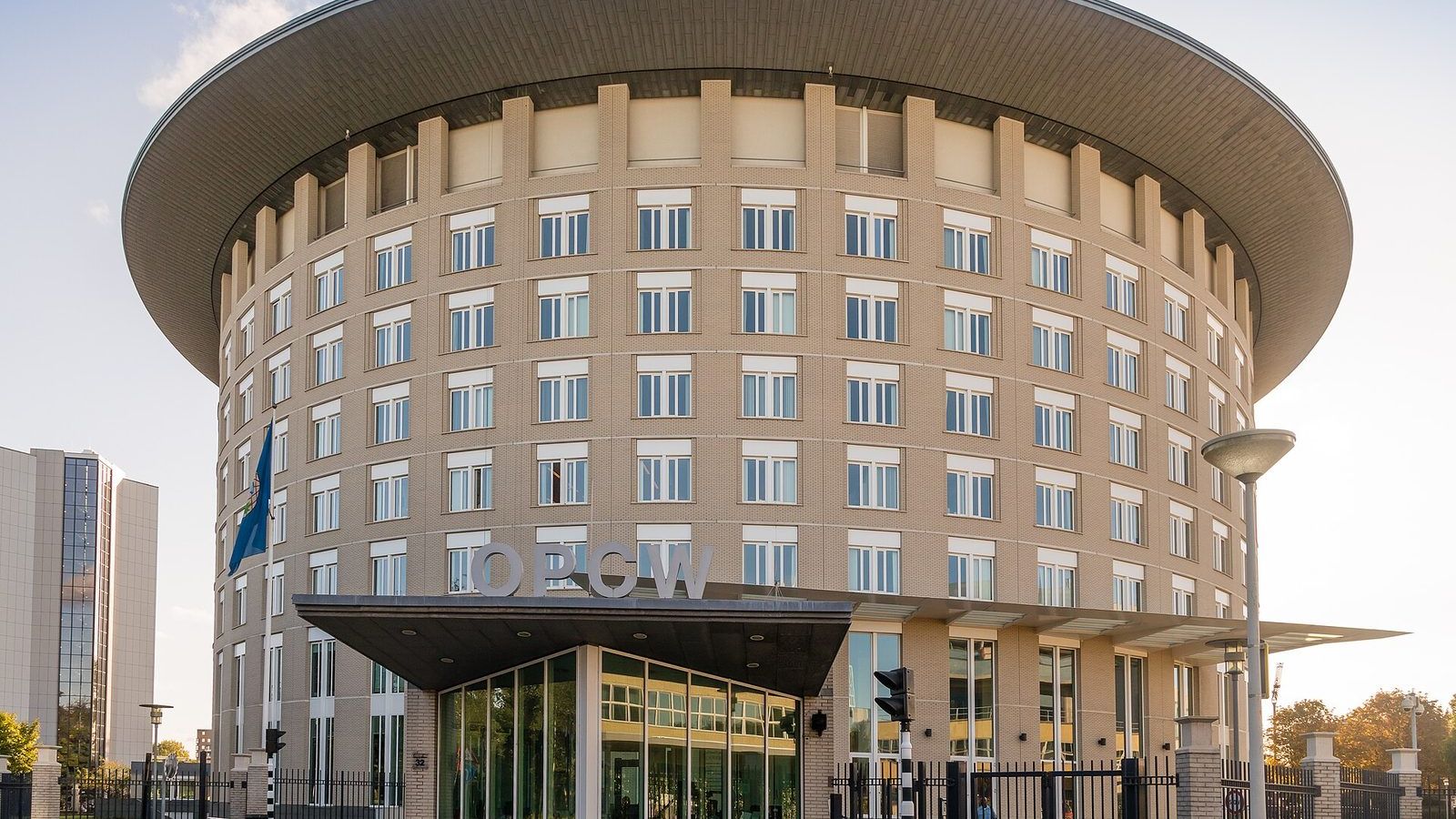
The Convention did what the Geneva Protocol had not. It banned the development, production, stockpiling, and transfer of chemical weapons as well as their use, required every party to declare and destroy its stocks and production facilities under international supervision, and created an inspectorate, the Organisation for the Prohibition of Chemical Weapons in The Hague, with the right to inspect any party's facilities. The OPCW now has 193 states parties, the same number as the United Nations has members, though not the same list: Egypt, North Korea, and South Sudan have never joined, Israel has signed but not ratified, and the Holy See and Palestine are parties. The organization received the Nobel Peace Prize in 2013. Its count of declared chemical agent verified as destroyed stands at just over 72,000 tonnes, every tonne that any party admitted to holding.
Internalization and its tests
The third stage is where the story stops being tidy. Syria joined the Convention in September 2013, three weeks after a sarin attack on the Damascus suburb of Ghouta that killed hundreds, and declared 1,300 tonnes of agent, which were removed and destroyed at sea and in several countries within a year. The OPCW and the United Nations then documented further attacks with sarin and chlorine in Syria between 2014 and 2018, and the OPCW's Investigation and Identification Team named the Syrian armed forces as responsible for several of them. The Convention's states parties suspended Syria's rights and privileges in 2021. Nerve agents were also used to attack individuals in Britain in 2018 and in Russia in 2020. None of this reversed the norm, and the diplomatic response to each case was built on the Convention's machinery, but it showed that an internalized norm is enforced by stigma and cost, not by magic, and that a government willing to pay the cost can still break it.
The number that matters is the one that did not move. No state has claimed a right to use chemical weapons since 1925; the users have denied using them. In Finnemore and Sikkink's vocabulary that is the signature of internalization. The cheaters conceal rather than justify, which means the standard itself is not in dispute. The nuclear taboo, which Nina Tannenwald has studied with the same tools, is weaker on exactly this point, because the nine nuclear-armed states openly keep the weapons and claim a right to use them in extremity. Unit 4 of the masterclass, on constructivism, identity, and norms, works through the life cycle with the Ottawa Convention on landmines as a second case, and Unit 16 returns to it to ask whether the same path is open for autonomous weapons and for the military uses of artificial intelligence, where the emergence stage is under way and the tipping point is not in sight.