Image: Ludovic Courtès, CC BY-SA 3.0, via Wikimedia Commons
The second tradition, from Kant's Perpetual Peace and Norman Angell to Keohane's After Hegemony. The unit recalls the Prisoner's Dilemma, works through Axelrod's tournament and tit for tat by hand, and derives the shadow of the future at which cooperation pays. It explains what institutions do for states, lowering transaction costs, providing information, and making commitments credible, with the first World Trade Organization dispute as the case, and it defines sensitivity and vulnerability interdependence. The democratic peace is presented as a regularity between pairs of democracies with its figures and its critics, and 1914 is examined as the hard case for the commercial peace.
Sample unit: the complete text
Every day, aircraft land in foreign countries under rules their crews did not write, letters cross borders for the price of a stamp, and goods worth tens of billions of dollars change hands between states that have no court above them. Unit 2 explained why cooperation between states is hard: there is no government above them, and a promise can be broken the moment it stops paying. This unit presents the tradition that starts from the same anarchy and reaches a different conclusion. Liberals hold that states cooperate far more than the fear of each other would predict, because of repeated dealings and the institutions built around them, trade and the dependence it creates, and the kind of government a state has at home. Each claim can be tested against evidence, and this unit tests all three, with the summer of 1914 as the hardest case the tradition has to face.
1 The liberal lineage
The word liberalism names a family of arguments rather than one theory, and the family has a founding text. In 1795 the philosopher Immanuel Kant (1724-1804), then seventy-one and teaching in Königsberg, published a short essay with the title Perpetual Peace: A Philosophical Sketch. He wrote it in the form of a peace treaty, with six preliminary articles (no secret reservations in a peace treaty, no standing armies in the long run, no interference in the constitution of another state, and so on) and three definitive articles that state the conditions under which peace could last. The three definitive articles are the frame of this unit, because each of them became a research programme two centuries later.
Kant also said why the first article should matter. If, under a republican constitution, “the consent of the subjects is required to determine whether there shall be war or not, nothing is more natural than that they should weigh the matter well, before undertaking such a bad business”, he wrote in Mary Campbell Smith’s translation of 1903, because in decreeing war the citizens “would of necessity be resolving to bring down the miseries of war upon their country”. They must fight themselves, pay the costs, and repair the damage, while a ruler who is not a citizen loses nothing of the kind. This is the oldest statement of what Section 5 calls the institutional explanation of the democratic peace. The three articles also give this unit its order, because Sections 2 and 3 test the second article with repeated games and institutions, Sections 4 and 6 test the third with interdependence and the war of 1914, and Section 5 tests the first with the record of wars between democracies.
The second strand of the lineage came from commerce. Richard Cobden (1804-1865), a Manchester cotton manufacturer, led the Anti-Corn Law League from 1838 until the British tariffs on imported grain were repealed in 1846, and in 1860 he negotiated the Cobden-Chevalier Treaty that lowered the tariffs between Britain and France. For Cobden free trade was a peace policy as much as an economic one, because he expected peoples who depended on each other’s markets to resist their governments’ wars. The most famous version of this argument was written half a century later by the journalist Norman Angell (1872-1967). His pamphlet of 1909 became the book The Great Illusion in 1910 and sold in many languages. Angell argued that in an economy built on credit and contract, conquest no longer pays: a victor who confiscates the wealth of the conquered destroys the credit on which his own wealth rests, and a victor who respects it gains nothing. Angell is often quoted as having said that war had become impossible, and he spent decades correcting this. In the preface to the 1913 edition he wrote that his argument “is not that war is impossible, but that it is futile”. He received the Nobel Peace Prize in 1933, and Section 6 returns to what his argument did and did not predict.
The third strand turned the ideas into institutions. On 8 January 1918, with the First World War in its fourth year, the American president Woodrow Wilson (1856-1924) set out fourteen points for a peace settlement before Congress. The first three asked for open diplomacy, freedom of the seas, and the removal of economic barriers between nations, and the fourteenth asked for “a general association of nations” that would give “mutual guarantees of political independence and territorial integrity to great and small states alike”. That association became the League of Nations, whose Covenant formed the first part of the Treaty of Versailles of 28 June 1919 and entered into force on 10 January 1920. Article 10 of the Covenant committed members to respect each other’s territorial integrity, Article 11 declared any war a matter of concern to the whole League, and Article 16 promised that a member who went to war in breach of the Covenant would face the severance of “all trade or financial relations” by all other members. The United States Senate refused to consent to the treaty twice, in November 1919 and March 1920, and the country that had proposed the League never joined it. The record of the League in the 1930s belongs to Unit 8.
Figure 1. The first session of the Assembly of the League of Nations in Geneva, November 1920, photographed by Frank-Henri Jullien. Credit: Frank-Henri Jullien, public domain, via Wikimedia Commons.
When E. H. Carr (1892-1982) published The Twenty Years’ Crisis in 1939, he called the thinkers of this tradition “utopians” who had mistaken their hopes for an analysis of how states behave, and the label “idealist” has stuck to them ever since. Liberals reject it, and the rest of this unit shows why: the claims of the tradition are claims about evidence, and they are tested with games, datasets, and documents like any other. The tradition has become a set of assumptions that its modern authors, above all Robert Keohane, Joseph Nye (1937-2025), and Michael Doyle, state as follows.
2 The problem of cooperation
Unit 1 introduced the Prisoner’s Dilemma, the two by two game in which each player does better by defecting whatever the other does, so that both end up defecting although both would prefer mutual cooperation. Table 1 shows the game with the payoffs that Robert Axelrod used in his tournaments: the temptation to defect against a cooperator \(T = 5\), the reward for mutual cooperation \(R = 3\), the punishment for mutual defection \(P = 1\), and the sucker’s payoff \(S = 0\) for cooperating with a defector. Played once, the game has one Nash equilibrium, which is mutual defection, and that equilibrium is where two states that arm against each other, raise tariffs against each other, or overfish a shared sea end up.
\(B\) Cooperates
\(B\) Defects
\(A\) cooperates
(3, 3)
(0, 5)
\(A\) defects
(5, 0)
(1, 1)
Table 1. The Prisoner’s Dilemma with Axelrod’s payoffs. Each cell gives the row player’s payoff first; the Nash equilibrium of the one-shot game, mutual defection, is set in bold.
States, however, rarely meet once. The same two governments negotiate tariffs this year and next, patrol the same border for decades, and sit in the same organizations for generations. In 1979 Axelrod, a political scientist at the University of Michigan, asked what strategy does best when the game is repeated, and he asked it in an unusual way. He invited game theorists to submit computer programs that would play the iterated Prisoner’s Dilemma, which is the same game played round after round between the same two players, against each other in a round robin tournament, in which every program meets every other program, with 200 moves per game and each pairing played five times. Fourteen entries came in from economists, mathematicians, political scientists, psychologists, and a sociologist, and a fifteenth program that chose at random was added. The winner was the simplest program submitted, tit for tat: cooperate in the first round, and then do whatever the other player did in the previous round. It averaged 504 points per game, where 600 is the score of two players who cooperate throughout and 200 the score of two who never do. Axelrod published the results, circulated them, and ran a second tournament in 1980 with 62 entries from six countries, many of them designed to beat tit for tat. Tit for tat won again.
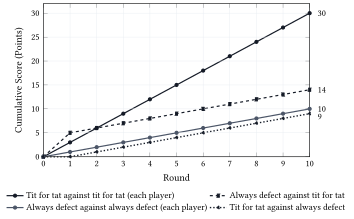
Why the simplest program won is the instructive part of the result. In Axelrod’s first tournament, every one of the eight highest scoring programs was “nice”, which means that it was never the first to defect, and none of the lower scoring programs was. Tit for tat never scores more than its opponent in any single game, since it can at most equal a cooperator and loses the first round to a defector, but it collects nearly the full reward from every cooperative program and pays only once to every exploiter. The following worked case shows this arithmetic over ten rounds.
Figure 2. Cumulative scores over ten rounds of the iterated Prisoner’s Dilemma with Axelrod’s payoffs, computed as in the worked case. Two tit for tat players reach 30 each; against a player who always defects, tit for tat loses only the first round and finishes with 9 to the defector’s 14, far below the 30 that cooperation would have given both.
Why does the repeated game change the result at all? Because a defection today is answered tomorrow, and tomorrow matters as long as there is likely to be one. Axelrod called the weight of the future the shadow of the future and measured it with a single number, the probability \(w\) that another round follows the current one. When \(w\) is small, the game is nearly a one-shot game and defection pays; when \(w\) is large, the loss of future cooperation outweighs the gain from a single defection. Between the two lies a threshold that can be computed.
Reciprocity in a game between two programs is one thing; cooperation among the 193 member states of the United Nations is another, and the tournament itself shows four limits. With many players it is often unclear who defected, so that retaliation hits the wrong party or nobody. When moves are observed with error, two tit for tat players who misread one cooperative move as a defection fall into a chain of mutual punishment, each answering the other’s last defection, that neither intended. When the last round is known in advance, defection pays in that round, because nothing can follow it, and then also in the round before, because a defection there can no longer be punished, and so on backwards until the whole structure unravels. And the shadow of the future is a property of the relationship, so a government that expects to be replaced, or a state that expects a war, gives the future little weight, or, in the language of the model, discounts it steeply. Each of these limits is a reason why states build institutions, the subject of the next section, and why they care about the expectations of others, the subject of Unit 4.
The program that won both tournaments was written by Anatol Rapoport (1911-2007), a professor of psychology and mathematics at the University of Toronto and one of the founders of peace research, and it was, as Axelrod wrote when he published the results, the simplest of all the programs submitted. Tit for tat is not the best possible strategy against any particular opponent, since always defect beats it in every game, but it does well with the whole population of strategies it meets. In his book The Evolution of Cooperation of 1984 Axelrod summarized the properties of successful strategies in four words: nice, retaliatory, forgiving, and clear. A government that is never the first to break an agreement, answers a breach at once, returns to cooperation as soon as the other side does, and is predictable in all of this, is practising diplomacy in the form of Rapoport’s program.
3 What institutions do
The realist of Unit 2 has a ready answer to Section 2: cooperation that rests on reciprocity between two players needs no institution, and cooperation among many players breaks down for the reasons just listed, so international organizations are either unnecessary or ineffective. The liberal reply was given its modern form by Robert Keohane in After Hegemony: Cooperation and Discord in the World Political Economy, published in 1984. Keohane accepted the realist starting point, namely that states pursue their own interests under anarchy, and asked what such states would want institutions for. His answer is a functional one, which means that it explains institutions by what they do for the states that create them: institutions are demanded because they do four things that the four limits of the repeated game require.
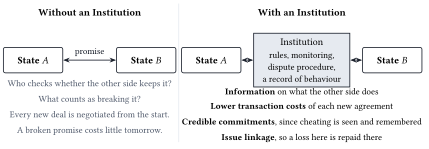
Figure 3 sets the four functions against the situation of two states without any institution. First, institutions provide information. A state that reports its tariffs, its arms holdings, or its emissions to a common body, and whose reports can be checked, lets its partners see whether it is keeping its word, and the problem of knowing who defected becomes solvable. Second, they lower transaction costs, which are the costs of negotiating, writing, and enforcing an agreement. Once a forum, a procedure, and a body of agreed definitions exist, the hundredth agreement is far cheaper to make than the first, which is why states that could in principle settle every question bilaterally still do most of their business in standing organizations. Third, they make commitments credible. A government that breaks a rule inside an institution is seen to break it by every other member, and its reputation in all future dealings in that institution suffers; the cost of one defection rises from the loss of one partner’s goodwill to the loss of many. Fourth, they allow issue linkage. Inside a regime that covers many subjects, a concession on one can be paid for by a concession on another, so that agreements become possible which no single issue would have allowed.
Figure 3. Two states with and without an institution. On the left, a promise between \(A\) and \(B\) raises four questions that neither can answer alone. On the right, the institution between them answers them through the four functions that After Hegemony (1984) describes: information, lower transaction costs, credible commitments, and issue linkage. Own drawing.
None of this requires an institution to have power over its members. In Keohane’s account institutions change the costs and the information on which self-interested states act, and that is all they need to do. The claim can be tested, and the test case that gave the book its title concerns what happened to the economic institutions founded after 1945 when the state that had founded them lost the position of dominance it had held.
If institutions are tools that states design for these functions, their design should vary with the problem, and it does. Barbara Koremenos, Charles Lipson, and Duncan Snidal set out five recurring design choices in a 2001 special issue of the journal International Organization on the rational design of institutions: membership, scope, centralization, control, and flexibility. Four of them matter here.
Membership can be universal or restricted to a club.
Scope can cover one issue or many.
Flexibility can be built in through escape clauses and review conferences, so that a member hit by a shock can bend a rule without breaking the regime.
Centralization decides whether enforcement rests on the members’ own retaliation or is delegated to a court or a panel.
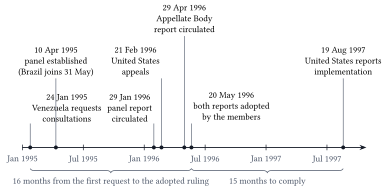
The World Trade Organization (WTO), founded on 1 January 1995 as the successor of the GATT, took the last option further than any other global institution, and its first dispute shows what a delegated procedure supplies.
Figure 4. The timeline of WTO dispute DS2, United States: Standards for Reformulated and Conventional Gasoline, from the first request for consultations to the United States’ report of implementation. Dates from the WTO’s case page and one-page summary, read November 2026. Own drawing.
The realist objection to all this was put by John Mearsheimer in a 1994 essay in the journal International Security, “The False Promise of International Institutions”, which Unit 2 presents as its research spotlight. His argument is that institutions reflect the distribution of power and the interests of the strong, that states worry about relative gains, that is, about who gains more from a deal, as well as absolute ones, and that the record shows institutions to have had little independent effect on whether states go to war. Keohane and Lisa Martin answered in the same journal in 1995. They accepted that institutions are created by the powerful for their own purposes and replied that this is exactly what the functional theory predicts; the question is whether, once created, institutions change outcomes, and the evidence of the trade and monetary regimes after 1971 says that they do. They also pointed out that the concern with relative gains is itself a reason to want institutions, because only an institution can supply the information that tells a state how the gains are being divided. The two positions still define the debate, and they share more than they dispute: both assume self-interested states under anarchy and disagree about how much the rules those states make then constrain them.
4 Interdependence as power
Institutions are the modern reading of Kant’s second article. The modern reading of the third, commerce and contact across borders, is interdependence, and its analysis also began with Keohane, this time with Joseph Nye, in Power and Interdependence of 1977. The book’s first point is that dependence between states is almost never symmetric, and that the asymmetry is a resource. Its second point is that two states can be dependent on each other in two different senses, and that the difference decides who holds the resource.
The argument was older than the book. The economist Albert O. Hirschman (1915-2012), who had watched Germany’s trade policy of the 1930s from exile, showed in National Power and the Structure of Foreign Trade (1945) how a large state can make small trading partners dependent on its market and then use the threat of closing it. A small state that sends a large share of its exports to one neighbour, and that cannot sell them elsewhere at short notice, has given that neighbour a lever; the neighbour, for whom the same trade is too small a share to notice, has given nothing comparable in return. The following case measures such an asymmetry with current data.
Hirschman’s lever is the dark side of interdependence. The bright side is the commercial peace, the claim of Cobden and Angell that states which trade heavily with each other fight less, because war would cost them the trade. The claim has been tested on the same kind of datasets that Section 5 uses, in which pairs of states are observed year by year, and the results depend on how trade is measured. John Oneal and Bruce Russett (1935-2023) found in a series of studies from 1997 onwards that pairs in which trade was large relative to the GDP of the more dependent partner had fewer militarized disputes, which are the threats, displays, and uses of force between states that fall short of war. Katherine Barbieri, measuring interdependence by the share of each state’s trade that went to the partner, found in 1996 that the most interdependent pairs had more militarized disputes rather than fewer. Erik Gartzke argued in 2007 that open capital markets and economic development, rather than trade as such, keep developed economies at peace, a pattern he called the “capitalist peace”. The sign of the relationship is therefore still argued over, and the argument is about measurement: whether dependence should be measured against the size of an economy, as the vulnerability concept suggests, or against the size of its trade.
5 The democratic peace
Kant’s first article made a prediction about republics, and in 1983 Michael Doyle checked it against the record. In two articles in the journal Philosophy and Public Affairs, “Kant, Liberal Legacies, and Foreign Affairs”, he listed the states with liberal constitutions since the eighteenth century and the wars between them and found that liberal states had fought many wars, but almost none against each other. The finding set off the largest research programme in the field, and what the programme claims has to be stated exactly, because it is often overstated.
The strength of the regularity is best seen in numbers, and the following case takes them from one of the first studies to test it against the whole record of pairs of states.
Two explanations compete, and both go back to Kant. The institutional explanation says that democratic leaders are constrained: they need the consent of legislatures and voters who bear the costs of war, they can be removed for a war that goes badly, and their decisions are visible to other governments, which makes their threats and their promises easier to read. Two such governments facing each other can therefore bargain their way out of a crisis that two governments whose decisions are hidden from each other cannot. The normative explanation says that democracies settle their domestic conflicts by compromise and law and extend the same expectations to other states they recognize as democracies, while expecting nothing of the kind from autocracies; this predicts peace within the group and no restraint outside it, which fits the dyadic pattern.
The critics have attacked the finding at several points. Christopher Layne, in the 1994 essay “Kant or Cant” in International Security, examined four crises in which democracies came close to war, such as Britain and France at Fashoda in 1898, and argued that they were resolved by calculations of power rather than by shared norms. David Spiro, in the same issue, argued that democracies were so few and so far apart for most of the record that zero wars between them is close to what chance would produce; Bremer himself had computed the probability of seeing zero wars in his 21,644 democratic pair-years if democracy made no difference, and found it near one in a thousand, which is small but, as he put it, far from impossible. Henry Farber and Joanne Gowa showed in 1995 that the regularity is strong only after 1945, when the democracies were allies against a common adversary, and asked whether common interests rather than common institutions explain the peace. Gartzke’s capitalist peace of 2007 attributes the pattern to the development and open markets that democracies happen to share.
The coding of democracy is itself disputed in the borderline cases, as Table 2 shows: whether Spain in 1898 or Imperial Germany in 1914 counts as a democracy decides whether the record has zero exceptions or a few. Håvard Hegre, whose forecasting work is the spotlight of Unit 1, reviewed thirty years of this debate in 2014 and concluded that the dyadic finding has largely withstood the objections, while the question of whether democracy itself is the cause, rather than the development and the interests that come with it, remains open. What would settle it is more history: as the number of democracies has grown, the number of pairs in which the regularity can fail has grown with it, and the next decades of data are the test.
6 1914 as the hard case
Every tradition has a case that its critics cite first, and for the commercial peace that case is the summer of 1914. Europe before the First World War was more integrated by trade, capital, and migration than it would be again until the 1970s, Britain and Germany were each other’s major customers, and they went to war within weeks of a crisis in the Balkans. The following case measures how large the ties were, from the two governments’ own statistical yearbooks.
What, then, had Angell claimed? The 1913 preface quoted in Section 1 gives the answer. He had claimed that war between such economies would be futile, and he had never claimed that it would not happen; on his own claim the war is evidence for him. By 1918 both Britain and Germany were poorer than in 1913, the victors could not collect the indemnity they imposed, the payments demanded from the defeated, without damaging their own economies, and Angell’s sequel of 1921 was called The Fruits of Victory for that reason. The liberal theory of Section 4 makes a weaker claim still, that interdependence raises the cost of war and therefore lowers its probability, and a lowered probability is consistent with the war happening. Erik Gartzke and Yonatan Lupu examined the case on these terms in 2012, in International Security, and pointed out that the war did not begin between the most interdependent states of Europe. It began between Austria-Hungary and Serbia, in the far less integrated east of the continent, and spread to the interdependent west through the alliance commitments that Unit 2 described. On their reading, interdependence did what the theory says in the west and was absent where the war started. Realists answer that this concedes the point, because it was the alliances and the balance of power, and not the trade, that decided whether Britain fought, and that a theory which is overridden by alliances in the one case that matters most explains little. Unit 6 returns to 1914 with the bargaining model of war and asks a different question, why the governments of 1914 could not find a settlement that all preferred to the war they got.
A phrase that appears in every current debate about world politics also belongs to this tradition. The liberal international order is the name G. John Ikenberry has given to the set of institutions built mainly by the United States after 1945, namely the United Nations, the Bretton Woods bodies, the trade regime, and the alliances, together with the rules that they carried, which were open markets and multilateral decision, that is, decision among many states rather than by one. Ikenberry argued in 2018, in the journal International Affairs, that the order is in crisis but not finished; Mearsheimer argued in 2019, in International Security, that it was bound to fail because it rested on a unipolar moment that has passed. Whether the phrase describes the world of 1945 to 2008 accurately, and what, if anything, is replacing it, is the closing question of Unit 8, which compares the orders of 1648, 1815, 1919, 1945, and 1991. The realist and the constructivist accounts of that order, from Units 2 and 4, will be set beside the liberal one there.
This is one of 16 units
Participants also get the quiz, the further reading, and the final exam.