 Image: NASA, public domain
Why a satellite destroyed at 850 kilometres is a problem for decades
On 11 January 2007 a missile launched from Xichang in Sichuan climbed to about 865 kilometres and struck Fengyun-1C, a Chinese weather satellite that had stopped working two years earlier. The satellite weighed about 750 kilograms. Within months, radars on the ground had catalogued more than 2,000 fragments large enough to track, and the count eventually passed 3,500; most of them are still in orbit today, and will be for decades. On 15 November 2021 a Russian missile destroyed Kosmos 1408, a defunct reconnaissance satellite of about 1,750 kilograms, at about 480 kilometres. About 1,800 fragments were catalogued. By 2025 nearly all of them were gone. The two tests were similar in method and opposite in consequence, and the difference is 385 kilometres of altitude. This post explains why with one formula and one rule of thumb, which is what Unit 15 of the masterclass does at greater length.
What a fragment does
A satellite in a circular orbit at altitude h moves at a speed fixed by gravity alone. With the Earth's radius of 6,371 kilometres and its gravitational parameter of 3.986 times 10 to the power 14 cubic metres per second squared, the speed at 865 kilometres is about 7.4 kilometres a second and the time for one orbit is about 102 minutes. At 480 kilometres the speed is about 7.6 kilometres a second and the orbit takes about 94 minutes. Everything at those altitudes moves at those speeds, in every direction, which is the first point: a fragment of a satellite is not slower than a satellite. When two objects in crossing orbits meet, their relative speed is of the order of 10 kilometres a second, and the European Space Agency's standard comparison is that a one-centimetre fragment at that speed carries the energy of an exploding hand grenade. A fragment of ten centimetres destroys any satellite it hits and produces thousands of new fragments.
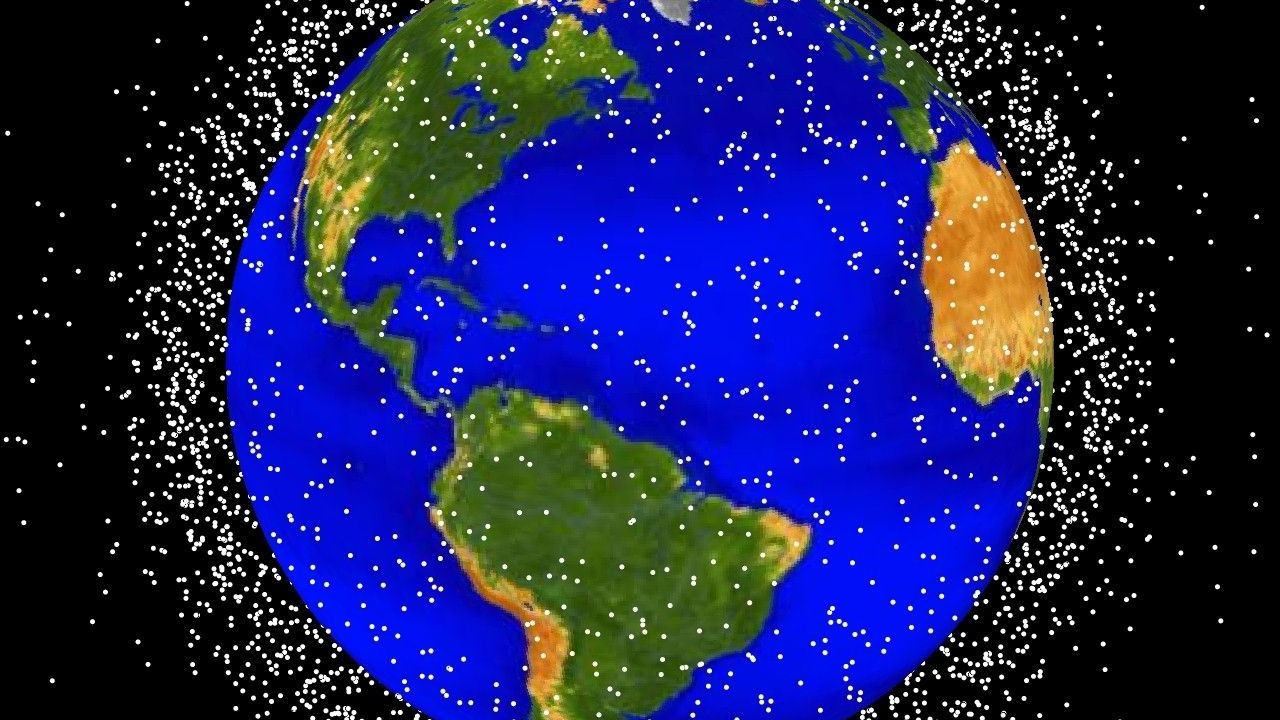
The fragments of a destroyed satellite do not stay together. They are thrown out at speeds of a few hundred metres a second relative to the parent, which puts them into orbits that are slightly higher or lower, slightly more or less inclined, and that spread around the Earth within weeks into a shell at roughly the parent's altitude. Some are kicked into orbits that reach well above the parent. The 2007 test produced fragments with high points above 3,000 kilometres.
Why the altitude decides
The only thing that removes a fragment from low orbit is the atmosphere. It does not end at any altitude; it thins out, and at a few hundred kilometres it is still thick enough to drag on a satellite, lower its orbit slowly, and eventually bring it down to burn up. The International Space Station, at about 400 kilometres, loses about two kilometres of altitude a month to drag and has to be pushed back up by visiting spacecraft several times a year; left alone it would re-enter within a year or two. The density of the thin upper atmosphere falls roughly by a factor of ten for every 100 kilometres or so of altitude in this region, and the time an object takes to fall out of orbit rises accordingly. The figures that NASA's Orbital Debris Program Office and ESA use as rules of thumb are these: an object at 400 kilometres comes down within a few years, at 600 kilometres within a few decades, at 800 kilometres within centuries, and above 1,000 kilometres it stays for thousands of years. The sun matters too, because the upper atmosphere swells when the sun is active, and the eleven-year solar cycle makes the numbers uncertain by a factor of two or so in either direction.
That is the whole explanation. Kosmos 1408's fragments started at 480 kilometres, where drag is strong, and most of them re-entered within three years; the fragments that were thrown higher took longer. Fengyun-1C's fragments started at 865 kilometres, where drag is weak, and the ones that were thrown lower have come down while the rest will take decades to centuries. The Indian test of 27 March 2019, at about 280 kilometres, and the American destruction of a failed satellite in February 2008, at about 250 kilometres, were conducted that low for exactly this reason, and their fragments were gone within about a year and eighteen months respectively, although some pieces of the Indian test lasted longer than its government had said they would.
The belt that keeps itself
Altitude explains why the 2007 test is still a problem. It does not by itself explain why the problem grows. In 1978 Donald Kessler and Burton Cour-Palais of NASA published a paper arguing that above a certain density of objects, collisions between them would produce fragments faster than the atmosphere removed them, so that the debris population would grow on its own even if no more satellites were launched. The region that worries them most is the one between about 750 and 1,000 kilometres, where drag is weak and where the heaviest traffic of the Cold War, weather satellites, spy satellites, and the upper stages of their rockets, was left. The collision between the working Iridium 33 and the dead Kosmos 2251 on 10 February 2009, at 789 kilometres, was the first between two intact satellites and added about 2,300 catalogued fragments to the same shell as the 2007 test. Whether the Kessler syndrome has already begun in that shell is argued about; what is agreed is that the number of objects there rises every year with no launches needed.
The counts to carry in your head, from ESA's 2025 report on the space environment, are about 40,000 tracked objects in orbit, of which about 11,000 are working satellites, and an estimated 1.2 million pieces between one and ten centimetres that cannot be tracked and can destroy a satellite. More than 7,000 of the working satellites are in one company's constellation at about 550 kilometres, an altitude chosen partly so that a failed satellite comes down within a few years. CelesTrak publishes the orbital elements of every catalogued object, including the Fengyun-1C and Kosmos 1408 fragments by name, and anyone can count how many are left.
Rules, so far
The Outer Space Treaty of 1967 requires states to avoid harmful contamination of space and to consult before any activity that might interfere with others, and it says nothing about weapons tests against one's own satellites, which all four testing states have argued are lawful. The change since 2021 has been a norm rather than a law. In April 2022 the United States committed itself not to conduct destructive direct-ascent anti-satellite missile tests, more than thirty states followed, and on 7 December 2022 the General Assembly adopted resolution 77/41 calling on all states to make the same commitment, by 155 votes to 9 with 9 abstentions; China, Russia, and India were not among the states voting in favour. The Secure World Foundation's annual assessment of counterspace capabilities tracks who has what and what they have promised. Unit 15 of the masterclass, on satellites, space, and security, derives the orbital formula, works the two tests through it, and then asks the harder question that the altitude argument leaves open: what a state that depends on satellites for its navigation, its communications, and its early warning should do about an adversary who can reach them.