

Cyber Operations and the Problem of Attribution
The first unit of the Advanced + Technology and Conflict masterclass, which takes the toolkit of Units 1 to 12 to technologies where the evidence is young. The unit explains networks, vulnerabilities, and the kill chain, then tells the record from the Morris worm of 1988 through Estonia 2007, Stuxnet, the Ukrainian grid attacks, NotPetya, SolarWinds, and Viasat, each with its dates and its public attribution. Attribution is separated into technical, operational, and strategic layers and worked through in natural frequencies, including a planted clue. Deterrence and the bargaining model are tested in cyberspace against the data showing that cyber operations have rarely changed outcomes, and the Tallinn Manuals, the eleven UN norms of 2015, and the cybercrime treaties close the unit.
On 17 June 2010 a small antivirus company in Minsk, VirusBlokAda, found a program on a customer’s computer in Iran that used a flaw in Windows nobody had reported, and within weeks the security firms of the world were taking apart the most elaborate piece of malicious software anyone had seen. It had one purpose, which was to damage a particular set of machines in one building near the town of Natanz, and to this day no government has admitted writing it. This unit opens the Technology and Conflict masterclass, in which the security dilemma, signalling, the bargaining model, norms, law, and deterrence from Units 1 to 12 are taken to four technologies where the evidence is young and the arguments are still open. Cyber operations are the oldest of the four, and they raise in its sharpest form a question that every later unit meets again, which is how a state can deter, bargain with, or bring to law an adversary it cannot name with confidence.
1 Networks, vulnerabilities, and the kill chain
The technology can be explained in a page. A network is a set of computers that exchange messages, cut into small packets, each carrying the address of the machine it is meant for; the Internet is a network of such networks, and nothing in its design checks where a packet really comes from. All software of any size contains flaws, and a vulnerability is a flaw that lets an outsider make a system do something its owner did not intend, such as run the outsider’s code. An exploit is the piece of code that uses the flaw, and a zero-day is a vulnerability that the maker of the software does not yet know about, so that no repair exists; the name counts the days the maker has had to fix the flaw, which is zero.
Malware is any software written for the intruder’s purposes, and three kinds appear in this unit. A worm copies itself from machine to machine without help, a wiper destroys data, and ransomware encrypts data and demands payment for the key. A botnet is a crowd of ordinary computers, infected without their owners’ knowledge, that an operator commands as one, and a distributed denial of service attack is what such a crowd does when it floods a website with requests until nobody else can reach it. The machines that run factories, power grids, and enrichment plants are controlled by programmable logic controllers, small industrial computers that switch motors and circuit breakers, the switches that connect or cut a power line, and that were designed for reliability rather than for defence. Finally, an intruder often breaks into something the target trusts, such as the maker of its accounting or network software, and rides in on the trusted channel, which is a supply chain attack.
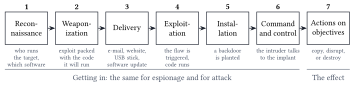
Figure 1 carries the most important distinction of the unit. Up to the sixth phase an operation that will steal documents and an operation that will open the breakers of a substation, the station where a power line is switched and its voltage changed, are the same operation, and the defender who finds an implant, which is the intruder’s program left running inside a network, cannot tell from the implant which of the two it is. Three kinds of effect follow from the seventh phase, and the words should be kept apart, because newspapers call all three “cyber attacks”.
- Espionage copies information and leaves the system working. It is by far the most common kind of state cyber operation.
- Disruption makes a service unavailable for a time without destroying anything, as a denial of service attack does to a website; the damage ends when the attack ends.
- Destruction or degradation deletes data so that it cannot be recovered, or makes machines in the physical world damage themselves or the things they control. This is the rarest kind, and the debate about cyber “weapons” is about it.
The neutral word for all three is a cyber operation; “attack” is reserved below for operations that disrupt or destroy, and the legal term “armed attack” is a different matter, treated in Section 6.