Image: Lt. Col. Leslie Pratt, US Air Force, via the Department of Defense, public domain; the appearance of US Department of Defense visual information does not imply or constitute endorsement
The unit explains what a machine learning model is and why it fails in unfamiliar conditions, with a published medical case as the evidence, and defines autonomy as a spectrum from remote control to full autonomy in the critical functions of selecting and engaging targets. It separates the automation of the 1980s, the Phalanx and the Aegis, from learning systems, surveys what has been fielded from Nagorno-Karabakh to Ukraine with every claim traced to a public source, and presents Michael Horowitz's argument that artificial intelligence is an enabling technology whose effect on the balance of power depends on diffusion and organizational adoption. The arithmetic of a false alarm explains why the chain that warns of a nuclear attack keeps a person in it; the law is set out through distinction, proportionality, precaution, and Article 36 reviews; and the governance debate runs from the eleven guiding principles of 2019 through three General Assembly votes to the Review Conference of November 2026.
Preview: the beginning of the unit
In the early hours of Saturday 21 November 2026, after five days and one long night in Geneva, the 128 states parties to the Convention on Certain Conventional Weapons closed their Seventh Review Conference without a mandate to negotiate a treaty on autonomous weapons, and gave their expert group two more years instead. The subject had been on the Convention’s agenda since 2013, and in those thirteen years the machines in question went from the conference room to the battlefields of Libya, Nagorno-Karabakh, Ukraine, and Gaza, if the reports are right. This unit separates what is known from what is claimed: what a machine learning model is and why it fails in unfamiliar places, what “autonomous” means in a weapon, what has actually been fielded, what artificial intelligence might change in the balance of power and the speed of war, what the law of armed conflict requires of any weapon, and what states have and have not agreed.
1 The technology in one section
Artificial intelligence is an old name whose meaning has changed with every decade. In this unit it means computer systems that perform tasks which, when a person performs them, are taken to require intelligence, such as recognizing a tank in a photograph. Almost everything that now carries the name is machine learning, a way of building such a system without writing its rules by hand. A machine learning model is a mathematical function with a very large number of adjustable numbers, called parameters, and it is built by fitting those numbers to examples. For a system that is to tell tanks from trucks, the examples are thousands of labelled pictures, and “learning” means adjusting the parameters, a little at a time, until the model’s answers on the examples agree with the labels. Nothing in the procedure tells the model what a tank is; it finds whatever features of the pictures predict the label and uses them.
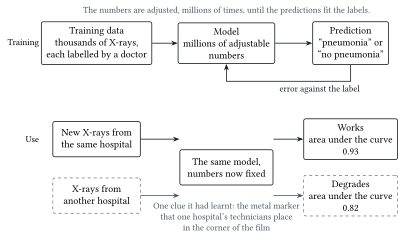
The second consequence is the one that matters for weapons. A model learns whatever in its training data predicts the labels, and the clue it finds is often not the one a person would use. When the data it meets in use differ from the data it was trained on, which engineers call a distribution shift, the clue may be gone or may point the wrong way, and the model fails without any sign that it is failing, since it reports the same confident scores as before. The clearest documented cases come from medicine, where the data are public and the mistakes were measured; Figure 1 draws the mechanism and the case gives the numbers.
Figure 1. How a machine learning model is trained and why it fails away from its training data. In training, the model’s adjustable numbers are changed until its predictions fit the labels; in use, the numbers are fixed. The lower row is the chest X-ray study of the worked case: on new X-rays from the hospitals it was trained on the model performed well, on X-rays from a third hospital it degraded (the numbers are the area under the curve, the standard score for a classifier, which the worked case explains), and one clue it had learnt was a metal marker that one hospital’s technicians place on the film. Own drawing.
We use cookies to understand how the site is used and to measure activity. See our privacy notice.