 Image: Unknown photographer, 1914, public domain
Why states fight when war ruins both sides
War is expensive for the winner as well as the loser. Soldiers die, cities burn, trade stops, and at the end the two sides sign a settlement that divides whatever they were fighting over. Here is the puzzle that political scientists have worked on since the 1990s: that final settlement was available before the war. If both sides had agreed to it on the first day, each would have ended up with the same share and neither would have paid the costs of fighting. A war, looked at this way, is a failure to find a deal that both sides preferred to it. The question is why the deal is missed.
Drawing the range
James Fearon of Stanford University set the problem out in a paper published in 1995 in the journal International Organization, "Rationalist Explanations for War", and his way of drawing it has become standard. Imagine the thing in dispute, a province or a trade route, as a line from 0 to 1, and call the two states A and B. If they fight, A wins with some probability p and takes everything; B wins with probability 1 minus p. Fighting costs each side something, written as a share of the good: cA for A and cB for B.
A's expected result from war is therefore p minus cA, and B's is 1 minus p minus cB. Any peaceful division that gives A at least p minus cA is better for A than fighting, and any division that gives B at least its expected result, which means giving A no more than p plus cB, is better for B. So every division of the line between p minus cA and p plus cB is preferred by both sides to war. That interval is the bargaining range, and as long as the costs of war are above zero, it exists.
Put numbers in. Suppose A would win with probability 0.6 and each side's cost is 0.1. A accepts anything from 0.5 upward; B accepts anything up to 0.7. Every split from 50:50 to 70:30 beats war for both. Double the costs to 0.2 each and the range widens to 0.4 to 0.8. Halve them to 0.05 and it shrinks to 0.55 to 0.65. Costlier wars leave more room for peace, which is one reason the arrival of nuclear weapons changed the calculations of the great powers.
Three ways to miss the deal
Fearon's point was that the old explanations, that leaders are irrational, that they miscalculate, or that they gain from war while their people pay, do not by themselves explain why rational leaders would miss a deal that is better for everyone. He found three mechanisms that do.
The first is private information with an incentive to misrepresent it. Each side knows things about its own strength and resolve that the other does not, so they may disagree about p. If A believes p is 0.8 and B believes it is 0.4, A will accept nothing below 0.7 and B will offer nothing above 0.5, and there is no overlap. Talking does not fix this, because each side has reason to exaggerate: a state that admits weakness gets a worse deal. Threats are cheap, so they are discounted. Only costly signals, mobilizing troops or staking a leader's reputation in public, carry information, and sometimes the only convincing signal is to fight.
The second is the commitment problem. Suppose both sides agree about p today, and today it is 0.6, but B is growing and next year p will be 0.4. A deal struck today at 0.6 will be renegotiated next year at 0.4, and there is nothing B can promise now that will bind it then, because no authority exists above the two states to enforce the promise. A may prefer war now, at 0.6 minus its cost, to a peace that slides to 0.4 and below. This is the logic of preventive war, and it is driven by a shift in power rather than by any threat B has made.
The third is indivisibility: some goods cannot be split, so no point in the middle of the line is available. A holy city, a throne, or a question of who governs a whole country are the usual examples. Fearon himself thought this the weakest of the three, since side payments and shared arrangements can often divide what looks indivisible, and later scholars have treated indivisibility as something leaders construct rather than find.
The summer of 1914
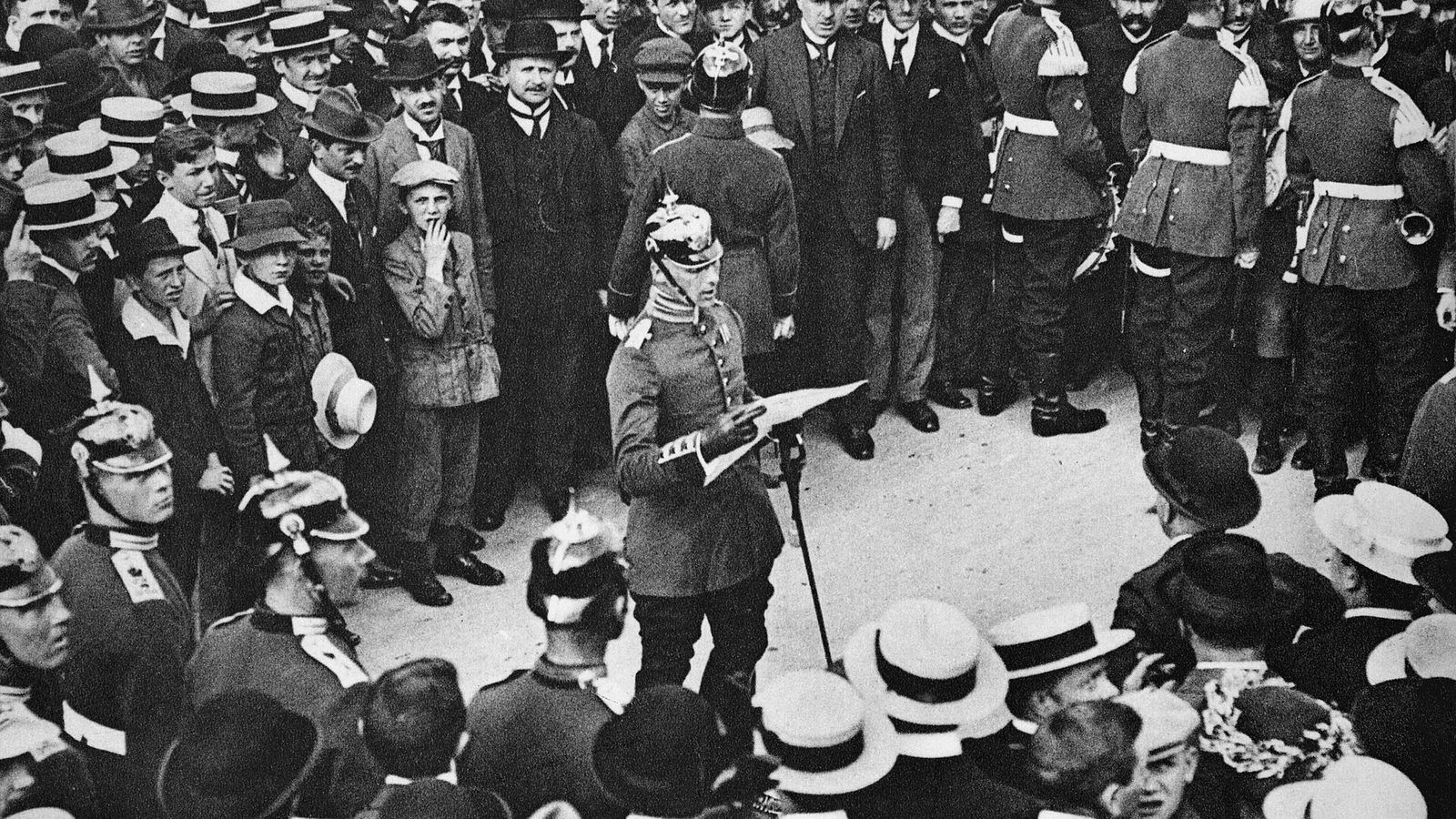
The July crisis is the standard test because it is so well documented. Archduke Franz Ferdinand was shot in Sarajevo on 28 June 1914. Austria-Hungary delivered its ultimatum to Serbia on 23 July, declared war on 28 July, and began shelling Belgrade the next day. Russia ordered general mobilization on 30 July. Germany declared war on Russia on 1 August and on France on 3 August, and invaded Belgium on 4 August, at which point Britain declared war on Germany. Five weeks separate the assassination from a general European war that none of the governments had wanted a year earlier.
Each of Fearon's mechanisms is visible in the record. Private information: the German government did not know until the last days whether Britain would fight, because the British foreign secretary Edward Grey had kept his commitments to France deliberately vague, and Berlin's calculations of p depended on the answer. The commitment problem: the German general staff believed that Russia's rearmament programme would make it unbeatable by 1917, and the chief of staff Helmuth von Moltke argued in those words for war sooner rather than later; a growing Russia could not credibly promise to use its future strength gently. Mobilization plans added a mechanical pressure of their own, because each army's timetable assumed it would strike first, and a day's delay looked like defeat. Whether 1914 was mainly an information failure, mainly a commitment problem, or something that no rational model captures is still argued, and the two best-known recent histories of the crisis, by Christopher Clark and by Margaret MacMillan, weigh the evidence differently. Unit 6 of the masterclass presents both without choosing.
What the model is good for
The bargaining model does not predict wars. What it does is tell you what to look for when one threatens: a disagreement about relative strength that talk cannot resolve, a shift in power that makes today's deal worthless tomorrow, or a claim that has been declared indivisible. It also explains why wars end. Fighting reveals the information that bargaining could not, and once both sides have learned what p really is, a settlement inside the range becomes possible again. Unit 6 draws the range, sets Fearon's three explanations out as a numbered box, and tests them against 1914 and the Gulf crisis of 1990. Unit 1 introduces the two by two game that the model builds on, and Unit 5 covers the signals, threats, and private assurances that leaders use to close the information gap. The order is on the curriculum page.