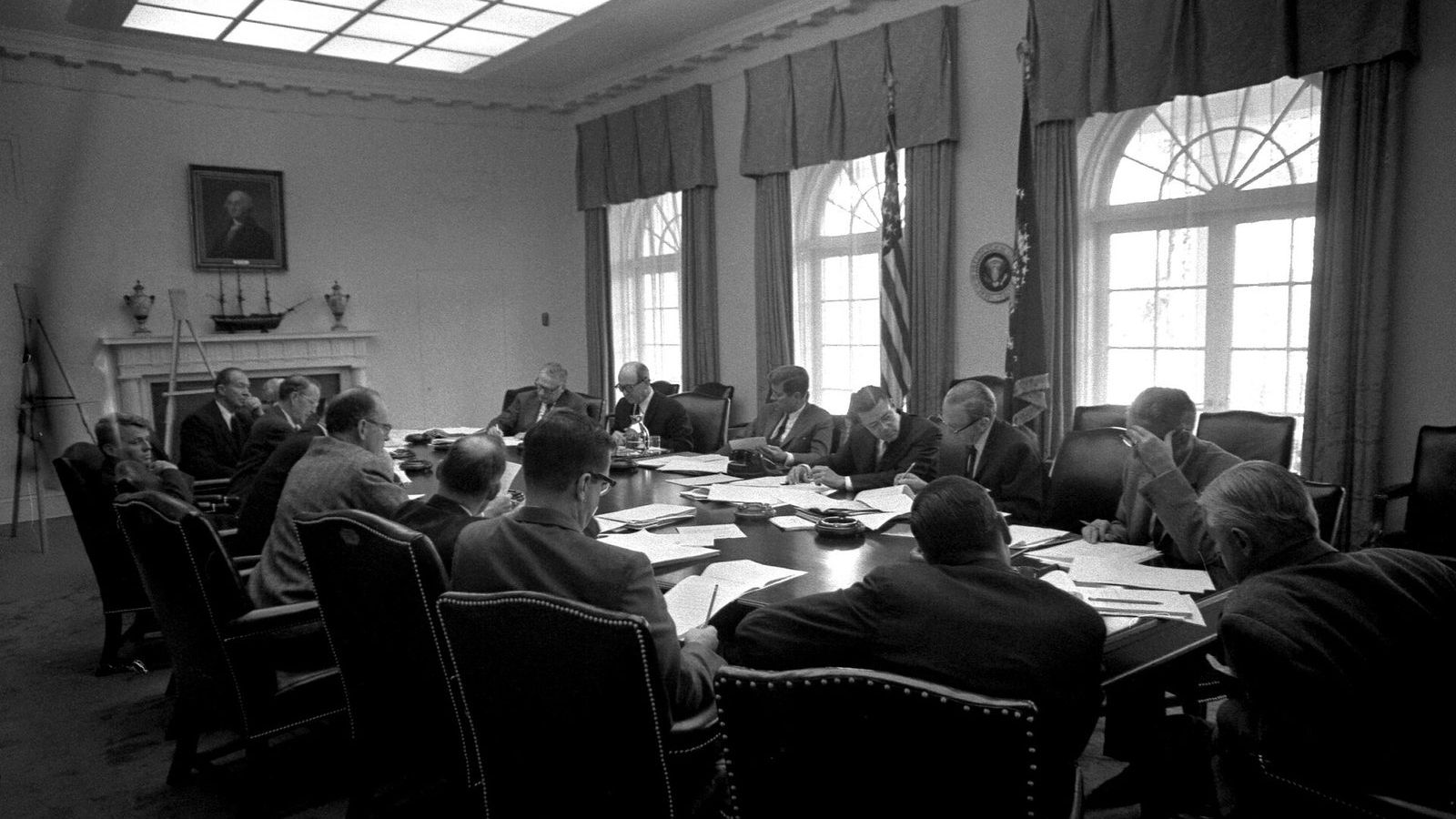
 Image: Cecil Stoughton, White House, public domain
How the Cuban Missile Crisis was settled in thirteen days
On the morning of Tuesday 16 October 1962, McGeorge Bundy walked into President Kennedy's bedroom with photographs taken two days earlier by a U-2 aircraft over western Cuba. Analysts had identified the launch pads of Soviet medium-range missiles near San Cristóbal from the spacing of the pads and the tents around them. Thirteen days later, on the morning of Sunday 28 October, Radio Moscow broadcast a message from Nikita Khrushchev announcing that the missiles would be dismantled and shipped home. What happened in between is the most studied negotiation of the twentieth century, and the documents released since the 1980s have changed the story in ways that matter for anyone who wants to understand how bargaining under threat works.
The first week: deciding what to do
Kennedy convened a group that came to be called the Executive Committee of the National Security Council, the ExComm, and for six days it met in secret while the president kept his public schedule. The options discussed ran from doing nothing, through a naval blockade, to an air strike on the missile sites and a full invasion of Cuba. The tapes Kennedy secretly made of these meetings, now transcribed and published, show the Joint Chiefs of Staff pressing for a strike and the president worrying about what the Soviet Union would do in Berlin in reply.
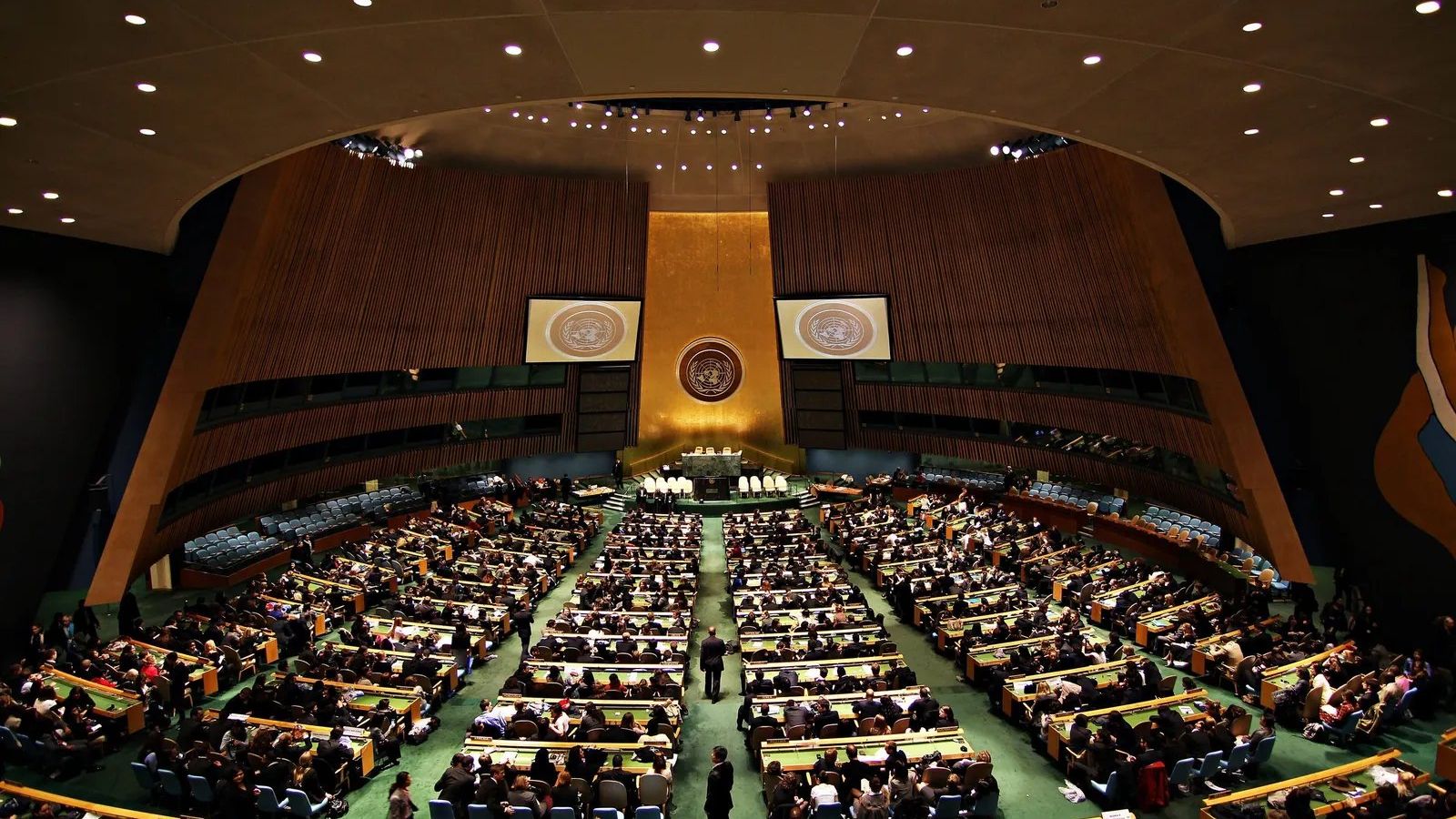
The choice fell on a blockade, called a quarantine because a blockade is an act of war under international law. Kennedy announced it on television on the evening of Monday 22 October. The quarantine took effect at 10 in the morning on Wednesday 24 October, and Soviet ships carrying military cargo stopped or turned back short of the line that day. On 25 October the US ambassador Adlai Stevenson showed the reconnaissance photographs at the Security Council of the United Nations, in the exchange in which he told his Soviet counterpart he was prepared to wait for an answer until hell froze over.
The quarantine solved one problem and not the other. It stopped more missiles from arriving. The missiles already in Cuba were being made ready at a pace that the daily reconnaissance flights could measure, and by the end of the week the ExComm believed that some would be operational within days.
Two letters in twenty-four hours
On the evening of Friday 26 October a long, personal letter from Khrushchev reached Washington. It was emotional and rambling, and it contained an offer: the Soviet Union would remove the missiles under United Nations observation if the United States pledged not to invade Cuba. On the morning of Saturday 27 October, before the ExComm had agreed a reply, Radio Moscow broadcast a second letter, formal and public, which added a condition. The United States would also have to remove its Jupiter missiles from Turkey.
The Jupiters were fifteen medium-range missiles, obsolete and liquid-fuelled, which the United States had deployed in Turkey under a NATO agreement; they had become operational only that year. Kennedy had himself remarked in the ExComm that they were of little military value. Removing them under Soviet pressure was a different matter, because Turkey had not been consulted and the NATO allies would read a trade as a sign that the United States would bargain away their security to protect its own.
Saturday 27 October was the worst day of the crisis. A U-2 flown by Major Rudolf Anderson was shot down over Cuba by a Soviet surface-to-air missile, and Anderson was killed. Another U-2 strayed into Soviet airspace over Siberia on a routine air sampling mission. At sea, US destroyers dropped practice depth charges to force a Soviet submarine, B-59, to the surface, without knowing that it carried a nuclear torpedo. The ExComm debated whether to answer the second letter, the first, or neither.
The decision was to answer the first letter and ignore the second, a tactic later named the Trollope ploy after the novels in which a woman treats a squeeze of the hand as a proposal of marriage. Kennedy's reply, sent on the evening of 27 October, accepted the offer of the Friday letter: the missiles out under UN supervision, in return for a lifting of the quarantine and an assurance against invasion. It said nothing about Turkey.
The meeting at the Justice Department
At about a quarter to eight that evening, the president's brother Robert Kennedy, the attorney general, received the Soviet ambassador Anatoly Dobrynin in his office at the Justice Department. Two accounts of the meeting survive, and reading them side by side is one of the exercises of Unit 5 of the masterclass. Robert Kennedy wrote a memorandum for the secretary of state, Dean Rusk, dated 30 October, which the National Security Archive publishes among its Cuban Missile Crisis documents. Dobrynin sent a cable to Moscow the same night, which was published in translation in the 1990s.
Both agree on the substance. Robert Kennedy told Dobrynin that the missile bases had to be dismantled and that the United States needed an answer the next day; otherwise it would remove them itself. He conveyed the public offer, the non-invasion pledge for the withdrawal. When Dobrynin raised Turkey, Kennedy said that the president had long wanted the Jupiters removed and that they would be gone within four or five months, on the condition that the arrangement was never made public. If the Soviet side announced it, the promise would be withdrawn. Dobrynin's cable records the assurance in more definite words than Kennedy's memorandum, which is what one would expect: each man wrote for his own government.
The assurance stayed secret. The Jupiters were removed from Turkey by April 1963. Members of the ExComm who wrote memoirs in the following years omitted the Turkish side of the settlement, and the public version of the crisis for a quarter of a century was that Kennedy had stood firm and Khrushchev had backed down. The former speechwriter Theodore Sorensen acknowledged at a conference in Moscow in January 1989 that he had edited the Turkish assurance out of Robert Kennedy's posthumous book. The crisis had been settled by a trade, and only one half of the trade had been visible.
What the settlement teaches
Negotiation theory, which Unit 5 presents in full, has a vocabulary for what happened. Each side had a best alternative to agreement, and both alternatives were terrible: an air strike with Soviet retaliation on one side, the loss of the missiles under fire on the other. That made the zone of agreement wide. Khrushchev needed a result he could present at home as a gain, and the non-invasion pledge served; Kennedy needed one that did not look like a concession extracted by threat, and the secrecy of the Jupiter promise served.
The two letters show the difference between private and public commitments. A public demand, such as the Turkish condition broadcast on Saturday morning, ties a leader's hands in front of his own public and his allies. A private assurance can be given without that cost, and it can be given with a deadline attached, as Robert Kennedy attached one. The ExComm tapes also record how much the decision makers feared losing control of events: the shot-down U-2, the submarine, and the stray aircraft over Siberia were none of them ordered by either leader, and each could have started a war the leaders were trying to avoid.
There is one more point, and it is about evidence. For twenty-five years the standard account of the crisis rested on memoirs written by participants with reasons to leave things out. The declassified record, including Robert Kennedy's own memorandum, corrected it. Unit 5 of the masterclass tells the thirteen days from those documents, and Unit 9 returns to 27 October 1962 from the other side, the submarine B-59 and the arithmetic of deterrence. The curriculum shows where each sits.