The Causes of War
War as a bargaining failure: any outcome a war produces could in principle have been agreed without its costs, so the question is why agreement fails. The unit draws and computes Fearon's bargaining range, states the three rationalist explanations, private information, commitment problems, and indivisibility, and tests each on a case, from the invasion of Kuwait in 1990 to the July crisis of 1914. It revisits misperception, diversionary war, regime type, and power transition, presents the Thucydides Trap as a count under debate, and shows in the Correlates of War and Uppsala data that the number of new interstate wars has not fallen since 1945 while battle deaths per person have, with the question whether that is a trend or luck left open.
On 2 August 1914, the first day of the French general mobilization, crowds in Paris stood in front of the posters and the first trains left the Gare de l’Est for the frontier; Germany declared war on France the next day. Within four years the war that began that week had killed about 8.6 million soldiers by the Correlates of War count, and it ended in a settlement, as every war does. That is the puzzle of this unit. A war is a very expensive way of reaching a result that could, in principle, have been written down beforehand, so the question is not why states have conflicting interests, which they always have, but why they sometimes fail to settle them without fighting. Unit 1 introduced the two by two game and Unit 5 the signals of a crisis; this unit puts them together in the bargaining model of war, tests its three mechanisms against cases, revisits the older explanations at the level of leaders, states, and the system, and ends with the July crisis of 1914 and with the question whether war between states has really become rarer.
1 War as a bargaining failure
Every war ends with some division of the thing that was fought over: a border, a government, a province, the right to pass through a strait. The division is reached after both sides have paid in lives and money. If the same division had been agreed on the day before the first shot, both sides would have had the same result without the costs. This observation is the starting point of the modern study of war, and it was stated in its sharpest form by James Fearon, then at the University of Chicago, in a paper published in 1995 in the journal International Organization, “Rationalist Explanations for War”. A bargaining failure is an outcome in which two parties fail to reach an agreement although an agreement exists that both would prefer to the alternative. War, in this view, is a bargaining failure with the highest possible stakes, and a theory of war must say what prevents the agreement.
The puzzle is only a puzzle if war is costly to both sides, which it is. The Correlates of War project, introduced in Unit 1, counts 95 wars between states from 1816 to 2007 in version 4.0 of its interstate war data, each with at least 1,000 battle deaths, and estimates that about 32 million soldiers died in them, of whom 8.6 million died in the First World War and 16.6 million in the Second. The Iran-Iraq war of 1980 to 1988, the largest since 1945, cost about 1.25 million lives by the same count. Civilian deaths, which these figures leave out, were larger still in the two world wars, and whatever each war settled was settled at a price that the winners also paid.
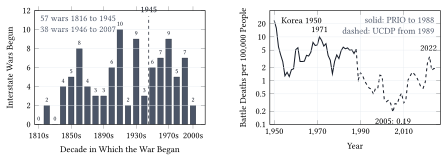
Has that price been paid less often since 1945? The data give an answer with two parts. The left panel of Figure 1 counts the interstate wars of the Correlates of War data by the decade in which they began, and the count does not fall after 1945: the 1970s, with nine new wars, matched the 1930s, and the 1960s, with seven, exceeded the 1900s. The right panel measures something else. It shows the number of people killed in battle each year for every 100,000 people alive, added up over all state-based armed conflicts, which are conflicts in which at least one of the fighting sides is a government, in the data of the Uppsala Conflict Data Program and its predecessor data from the Peace Research Institute Oslo. As Unit 1 explained, the Uppsala program counts an armed conflict from 25 battle-related deaths in a calendar year and a war from 1,000, and it counts the deaths of civil wars as well as of wars between states. That measure fell steeply, from about 24 per 100,000 in the first year of the Korean war, which is one person in about 4,000 killed in battle in a single year, to about 0.2 in 2005, which is one person in 500,000, before it rose again after 2011.