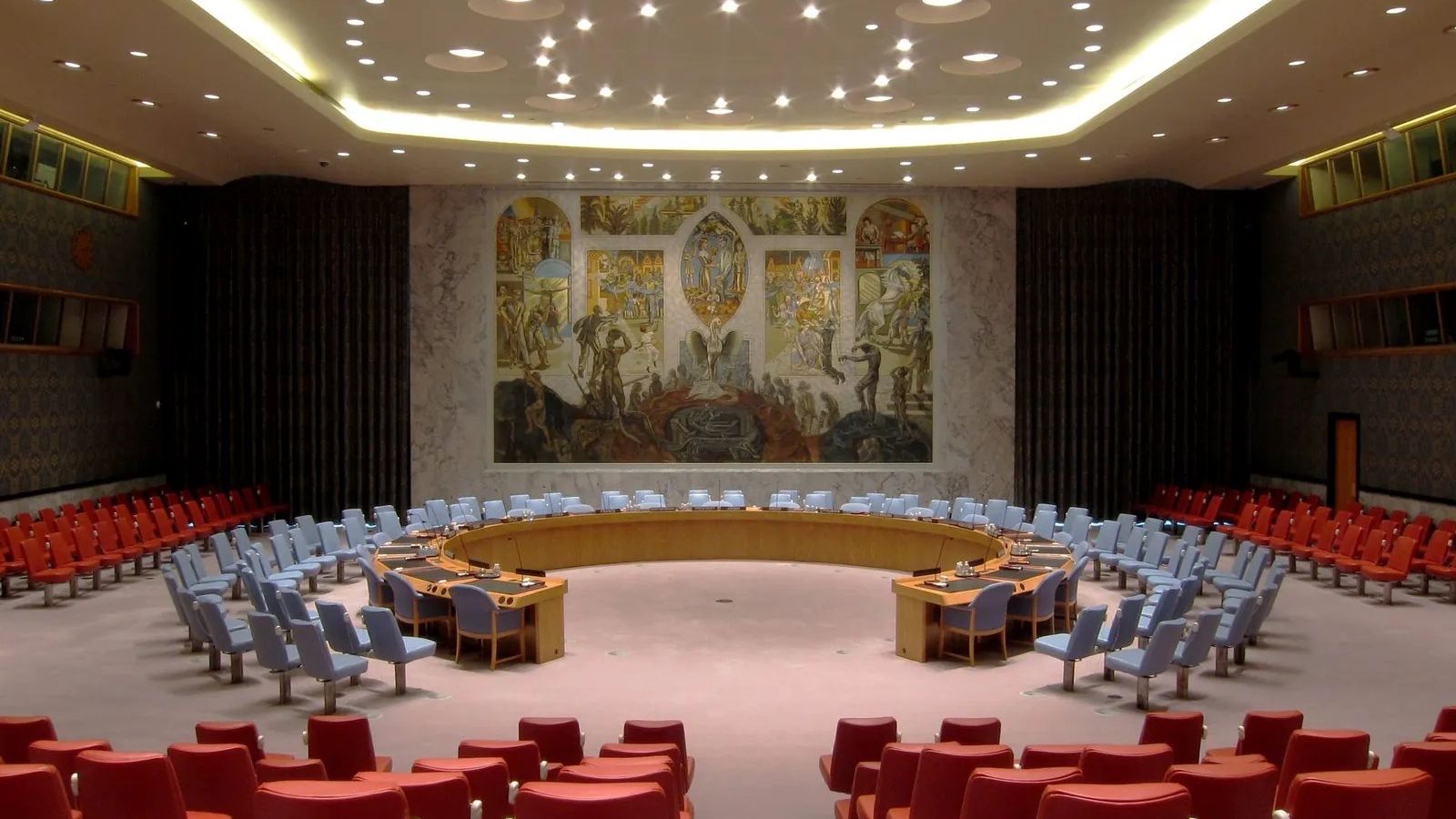
 Image: Mural by Per Krohg; photograph via Wikimedia Commons, CC BY-SA 3.0
How a Security Council vote really works
On 4 October 2011 the Security Council of the United Nations voted on a draft resolution about Syria, document S/2011/612. Nine members voted in favour, two voted against, and four abstained. The draft failed. A reader who knows only that the Council has fifteen members and that nine votes are needed will find that result strange, and a reader who knows that the Council has a veto will usually guess the reason without being able to say exactly what the rule is. The rule is in one paragraph of the Charter, and it is worth reading closely, because the way it is applied differs from the way it is written.
The paragraph
Article 27 of the Charter has three paragraphs. The first gives each member of the Council one vote. The second says that decisions on procedural matters are made by an affirmative vote of nine members. The third says that decisions on all other matters are made by an affirmative vote of nine members "including the concurring votes of the permanent members". The five permanent members, named in Article 23, are China, France, Russia (which took the Soviet Union's seat in December 1991), the United Kingdom, and the United States. The ten other members are elected by the General Assembly for two years at a time, five each year.
The number nine dates from 1965, when the Council grew from eleven members to fifteen and the majority from seven to nine. Nothing else in the article changed. The word veto does not appear in the Charter; the veto is simply the consequence of the words "concurring votes": a decision needs nine votes and the concurrence of all five permanent members, so a negative vote by any one of the five defeats a draft however many others support it. A draft with fourteen votes in favour and one permanent member against fails, as drafts have done many times.
The rule that is read differently
Read literally, "concurring votes of the permanent members" means that a permanent member that abstains has not concurred, so its abstention should defeat the draft too. That is not how the Council works. From the late 1940s the permanent members began to abstain without objecting that the resolution had failed, and the other members accepted the results as decisions. The International Court of Justice confirmed the practice in its advisory opinion on Namibia in 1971: a voluntary abstention by a permanent member, it said, has consistently and uniformly been interpreted as not constituting a bar to the adoption of a resolution. An abstention lets a permanent member signal disagreement without blocking the outcome, and it is used for exactly that.
So the working rule has two parts. A draft on a substantive matter is adopted if it receives at least nine votes in favour and none of the five permanent members votes against. Absence counts like abstention: the Soviet Union was boycotting the Council in June 1950 over the question of China's seat, and the resolutions that authorized the defence of South Korea passed in its absence.
Counting the vote of 4 October 2011
The record of the meeting, document S/PV.6627, is in the UN Digital Library, and the draft itself is listed on the veto list kept by the Dag Hammarskjöld Library. The draft, sponsored by France, Germany, Portugal, and the United Kingdom, condemned the violence against protesters in Syria and said the Council would consider measures under Article 41 of the Charter, which covers sanctions, if the situation did not improve.
In favour: Bosnia and Herzegovina, Colombia, France, Gabon, Germany, Nigeria, Portugal, the United Kingdom, and the United States. That is nine, the number the article requires. Against: China and the Russian Federation. Abstaining: Brazil, India, Lebanon, and South Africa. The nine votes were there; the two negative votes were cast by permanent members; the draft was not adopted. The four abstentions made no difference to the outcome. Had Brazil, India, Lebanon, and South Africa all voted in favour, the result would have been thirteen to two and the draft would still have failed.
The explanations of vote in the record show what each group of states wanted on the record. The abstaining members said they shared the concern about the violence and objected to the threat of sanctions and to what they saw as the risk of a path towards intervention, with the Libyan resolution of that March in everyone's mind. The two members voting against said much the same at greater length. The sponsors said the draft had been watered down repeatedly to meet those objections. The masterclass takes no side on who was right; the record is what the unit reads.
Two more cases for comparison
The Libyan resolution shows the other half of the rule. Resolution 1973 of 17 March 2011, which authorized member states to take all necessary measures to protect civilians in Libya and imposed a no-fly zone, was adopted by ten votes to none with five abstentions. Two of the five abstaining members were China and Russia, both permanent. Their abstentions did not block the resolution, and it became binding on every member of the United Nations under Chapter VII of the Charter. The same two governments, voting against instead of abstaining seven months later, defeated the Syrian draft. The choice between abstaining and voting against is the choice the rule gives a permanent member, and it is a political one.
The third kind of outcome is the draft that fails for want of nine votes with no veto cast at all. These are rarer and attract less attention, and the Library's research guide lists them separately. In those cases the elected members decided the result, which is a reminder that the ten elected seats are not decorative: a permanent member that wants a resolution adopted has to find nine votes, and the sponsors of the Syrian draft spent weeks doing exactly that.
Reading the numbers
Since 2022 every veto has had a sequel. The General Assembly decided in resolution 76/262 of 26 April 2022 that it would meet within ten working days of any veto to debate it, and the vetoing member is invited to speak first. The debate changes no outcome, and it makes the permanent member explain itself before 193 states. The Library's list, which runs from 1946 to the present and gives the document symbol and the meeting record of every veto, shows that the Soviet Union and Russia together have cast the most and the United States the next most, with the other three far behind; the list counts separate paragraphs and amendments as separate rows, so its total is higher than the number of defeated drafts.
Unit 7 of the masterclass teaches the voting rule with these cases and others, and it comes with a voting simulator in which you set the fifteen votes yourself and see whether the draft passes. The unit also covers what a resolution under Chapter VII can order that one under Chapter VI cannot, which is the difference the Syrian abstainers were arguing about. Unit 11 returns to resolution 1973 and the drafts that followed it when it takes up the responsibility to protect. Both are on the curriculum page.