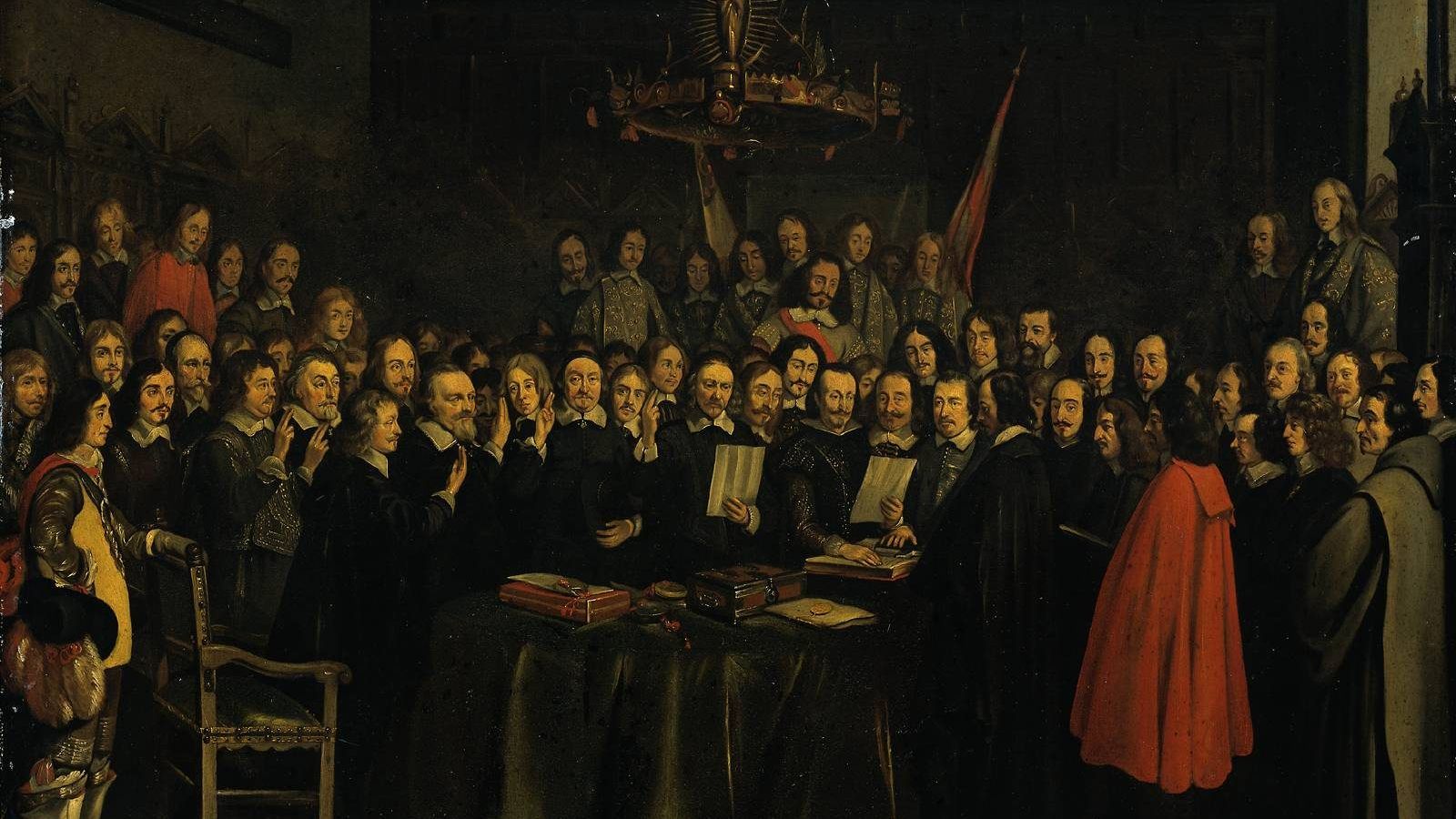
 Image: Gerard ter Borch, 1648, public domain
Did sovereignty begin in 1648?
Ask a student of politics when the modern state system began and the answer comes back at once: 1648, the Peace of Westphalia. The phrase "Westphalian sovereignty" appears in textbooks, in speeches at the United Nations, and in newspaper columns about whether that system is now ending. The treaties themselves are two long documents, signed in two towns on the same day, and anyone can read them in English on the Avalon Project site at Yale Law School. Reading them is a useful shock.
Two towns, five years, two treaties
The Thirty Years' War had begun in 1618 as a revolt in Bohemia and grown into a war that drew in Denmark, Sweden, France, Spain, and most of the German states. By the 1640s the fighting had exhausted everyone, and delegations gathered from 1643 in two Westphalian towns about 50 kilometres apart: Münster, where the Catholic powers and France negotiated with the Emperor, and Osnabrück, where Sweden and the Protestant estates did the same. Couriers rode between the two congresses to keep them in step. The negotiations took five years.
Three settlements came out of them. Spain made peace with the Dutch Republic in a treaty signed in January 1648 and sworn in Münster town hall on 15 May, the ceremony Gerard ter Borch painted. Then, on 24 October 1648, the Emperor signed a treaty with France at Münster and a treaty with Sweden at Osnabrück. These two are the Peace of Westphalia. They run to more than a hundred articles each, and most of those articles concern the things that had been fought over: which prince kept which town, who paid the Swedish army to go home, what happened to the Palatinate, and which religion could be practised where.
What the articles say
The passages that the sovereignty story rests on are Article VIII of the Treaty of Osnabrück and paragraphs 64 and 65 of the Treaty of Münster, which say the same thing in slightly different words. They confirm that the estates of the Holy Roman Empire, the several hundred princes, bishops, and free cities, hold their territorial rights, the ius territoriale, and that they may make alliances with each other and with foreign powers. There is a condition in the same sentence: such alliances may not be directed against the Emperor and the Empire, nor against the public peace, nor against this treaty.
That is a long way from sovereignty as the textbooks define it, which is supreme authority within a territory and independence from any authority outside it. The estates of 1648 remained inside the Empire. They sent representatives to the Imperial Diet, they were subject to the Imperial courts, and the Emperor remained their overlord in law. Their right to make alliances was confirmed, with a limit, and that right had existed in practice long before 1648. The religious articles extended the settlement of 1555, under which a ruler chose the religion of his territory, to include Calvinists, and fixed 1624 as the reference year for who owned which church property. Nothing in either treaty declares that states recognize no superior, that borders are inviolable, or that intervention in another state's affairs is forbidden.
The treaties also do not create a Europe of equal states. France and Sweden were made guarantors of the settlement, with a right to intervene in the Empire if it was broken, which is the opposite of non-intervention. The Pope protested the religious clauses and the treaty simply declared his protest void.
Where the story came from
The historian Andreas Osiander went through this evidence in a paper published in 2001 in the journal International Organization, under the title "Sovereignty, International Relations, and the Westphalian Myth". His argument was that the sovereignty reading of 1648 was built in the nineteenth century, when German historians hostile to the Habsburgs described the peace as the moment the Empire was hollowed out and the princes became independent, and that the field of international relations inherited the picture without checking it. A widely read article by the lawyer Leo Gross in 1948, written for the treaty's three hundredth anniversary, had fixed the date in the field's memory as the start of the modern system.
Not every historian accepts every part of Osiander's case. The Peace did matter: it ended a war that had killed a large share of the population of central Europe, it settled the religious question in the Empire for good, and it was negotiated at the first general congress of European powers, with procedures for precedence and credentials that later congresses copied. The political scientist Stephen Krasner, in his book Sovereignty: Organized Hypocrisy of 1999, made a related point from the other side: the principles attached to the Westphalian label have been violated so regularly, by the powers that proclaimed them, that they are better understood as a script rulers invoke when it suits them than as a rule that came into force on a particular day.
Why the label stuck anyway
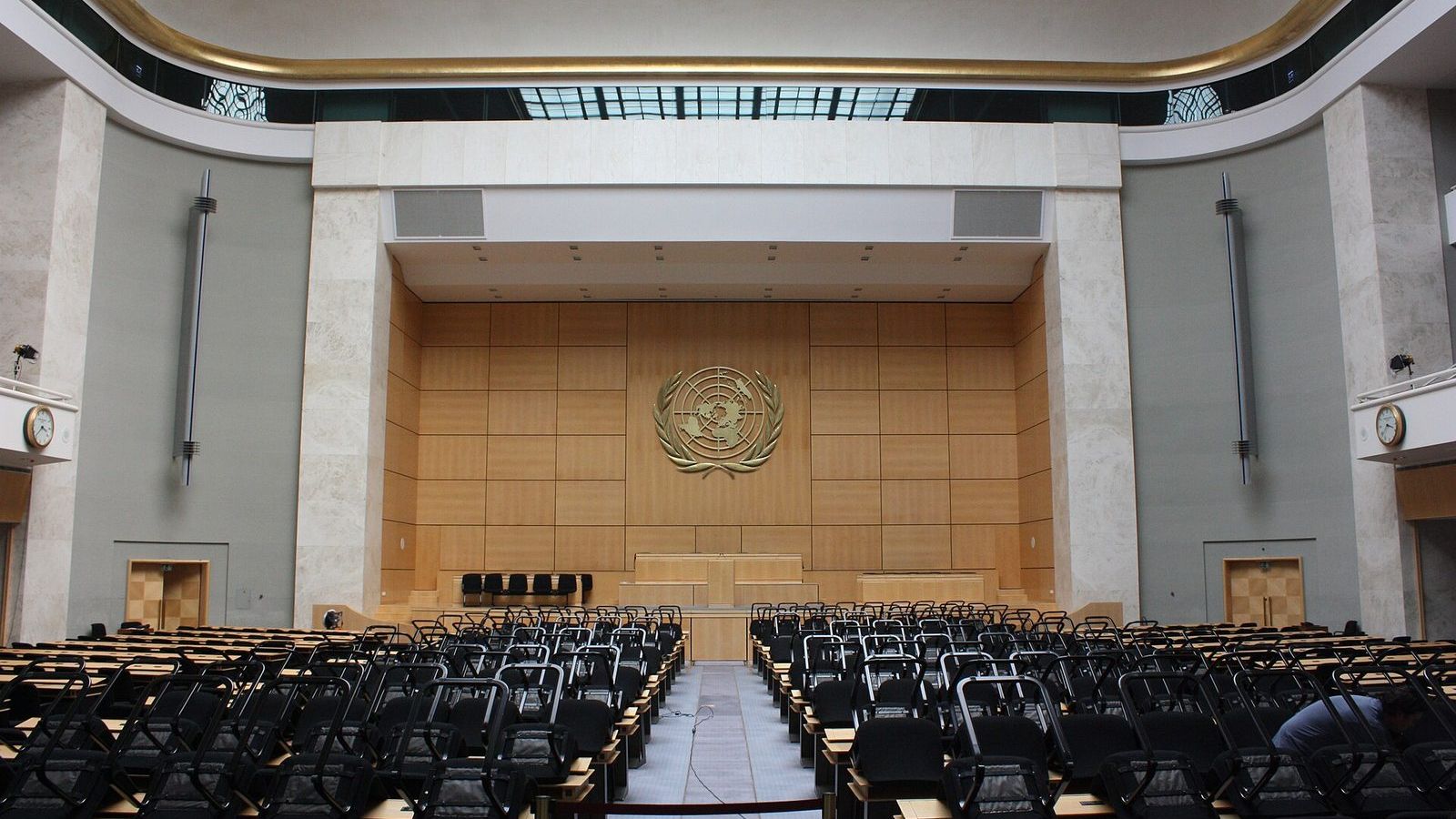
Labels survive because they are useful, and this one is useful in two ways. It gives a name to a bundle of ideas that did develop between the sixteenth and the nineteenth centuries: that the territorial state is the basic member of the international system, that its ruler answers to no outside authority on matters inside its borders, and that states deal with each other as legal equals whatever their size. Those ideas have a history that runs through the lawyer Emer de Vattel's book of 1758, the settlements of 1815 and 1919, and the Charter of the United Nations, whose Article 2 promises the sovereign equality of all members and forbids intervention in matters essentially within their domestic jurisdiction. Calling the bundle Westphalian is wrong about the date and right about the content.
The label is also useful to people who want to argue about the present. When a diplomat says that the Westphalian order is under threat, the claim is usually about intervention, about human rights overriding the domestic jurisdiction of a government, or about regional organizations such as the European Union whose members have pooled parts of their authority. When a scholar of China or India says that Westphalian sovereignty was a European invention imposed on the rest of the world through colonial treaties, that is a claim about whose rules the system runs on. Both arguments are easier to have with a date to point at, even an inaccurate one.
The habit worth acquiring is the one Osiander practised: when a date carries a large claim, read the document. The treaties of 1648 take an hour. Unit 8 of the masterclass, which traces world order from Westphalia through Utrecht, Vienna, Versailles, and San Francisco to the present debate, begins its first worked case with exactly those paragraphs, and Unit 1 reads Article 2 of the Charter clause by clause as its first treaty. The place of both units in the program is on the curriculum page.